Welcome! We invite you to register.
Glossary
First 20 results
Select
Kind of

Abeja Negra Canaria
The Canary black bee is a native breed present in Tenerife and the rest of the archipelago for thousands of years, even predating the arrival of humans. Its dark appearance, extremely docile nature, and extraordinary adaptation to the Canary climate and flora make it a key component of the island ecosystem and traditional beekeeping. In Tenerife, it has been essential for the pollination of endemic species and for the production of highly prestigious honeys, internationally recognized for their quality and diversity. Interesting Facts: It is a unique breed, genetically separated from other bees some 200,000 years ago, with its own markers developed in the Canary Islands. It is perfectly adapted to Tenerife, regulating its population according to the island's droughts and irregular flowering periods. It stands out for its docility, a key quality in a densely populated territory with limited topography. Beekeeping was already practiced by the Guanches, who collected honey from wild bees for food, medicinal, and ritual purposes. It was on the verge of extinction due to hybridization with non-native bees, which prompted an official protection plan in 2001. The honey produced by this bee in Tenerife is considered among the most prized in the world for its volcanic and floral origin.

Achamán
Achamán was the supreme god of the Guanches, the ancient inhabitants of Tenerife. He was considered the creator of the world, the sky, and humankind, a benevolent and all-powerful deity who reigned from the heavens. He was responsible for bringing rain, maintaining the balance of nature, and protecting his people. In contrast to Guayota—the spirit of evil and fire—Achamán represented light, harmony, and order. The Guanches venerated him with respect and gratitude, especially in times of need, asking for his help during droughts or volcanic eruptions. Interesting Facts His name means something like "he who is on high" or "he of the sky." He was believed to live on Mount Teide, considered a gateway between the earthly and spiritual worlds. In legends, it was Achamán who defeated Guayota when the latter kidnapped the sun (Magec) and imprisoned it inside the volcano. Some researchers see parallels between Achamán and other sky gods in ancient cultures, such as Zeus or Ra, although his identity is entirely Guanche. His figure symbolizes the spiritual connection of the Canarian people with nature, the mountains, and the sky, a connection that remains alive today in many of the islands' traditions and legends.

Agua de Panela
Panela water is a sweet and refreshing drink very popular in Latin America, especially in Colombia and Venezuela. It is made by dissolving panela (a block of unrefined sugar made from sugarcane juice) in water and lemon juice, sometimes with the addition of spices such as cloves or cinnamon. It can be served cold or hot. It has a natural, sweet flavor, different from refined sugar, and is drunk both for hydration and for quick energy. In the Canary Islands, it is known thanks to the influence of Latin American migration and is enjoyed in Venezuelan or Colombian cafes and restaurants. Fun Facts: Panela is a natural sugar that retains vitamins and minerals from the sugarcane, unlike refined sugar. When cold, it is called "agua de panela" and is refreshing; when hot, it resembles a comforting sweet tea. It is traditionally served with breakfast or as an energy drink after work or school. In some regions of Latin America, it is used as a base for desserts or mixed with coffee and milk. In the Canary Islands, the drink arrived with the Venezuelan community and is served in cafes or private homes as part of the local Latin American cuisine. It's a simple, inexpensive, and natural drink that pairs well with citrus or spicy flavors, depending on the recipe.

Alexander von Humboldt
Alexander von Humboldt (1769-1859) was a German scientist, explorer, and naturalist, considered one of the great pioneers of modern geography and biogeography. He visited the Canary Islands in 1799 and studied the islands' volcanoes, flora, fauna, and climate, especially Tenerife and Mount Teide. His observations helped to understand the relationship between altitude, climate, and vegetation, and laid the scientific foundations for volcanology and botany. Humboldt had a very holistic approach: he didn't just look at things in isolation, but rather how everything was connected in nature. Interesting Facts: His trip to the Canary Islands was part of a journey through the Americas and Spain, where he collected data on volcanoes, mountains, and currents. He climbed Mount Teide, took scientific measurements, and described the island's volcanic landscapes. He introduced concepts of climate, altitude, and vegetation that are still used in ecology today. He influenced later scientists, such as Charles Darwin, on the importance of direct observation. His writings on the Canary Islands include drawings and maps of volcanoes and plants that are still studied today. Humboldt promoted the idea that nature is an interconnected system, a vision ahead of his time. He is considered the first scientific tourist to visit the Canary Islands.

Almogrote
Almogrote is a spread typical of La Gomera, in the Canary Islands. It's made by mixing very hard goat cheese, garlic, olive oil, hot pepper, and sometimes tomato. It's all blended until it forms a thick paste, similar to a pâté with a lot of character. Its flavor is intense, slightly spicy, and very tasty, ideal for eating with bread or wrinkled potatoes. It's one of those dishes that was born to use up food and ended up becoming a symbol of local cuisine. Fun Facts: The name comes from "almodrote," a medieval cheese and garlic sauce very popular on the peninsula. It was created to use up cheeses that were already too hard to eat on their own. Traditionally, it's prepared in a mortar and pestle, although today many people make it with a blender. It's one of the most representative recipes of La Gomera and is usually served as a starter.

Amaro Pargo
Amaro Pargo was an 18th-century privateer and maritime merchant from Tenerife, and one of the island's most famous "pirates," linked to the Indies trade and commerce between the Canary Islands and the Caribbean. He participated in privateering actions against ships of enemy European powers, amassing a great fortune which he invested in properties and agricultural land, especially vineyards in Tenerife. Although popular tradition associates him with piracy and supposed hidden treasures, he was a practicing Catholic, recognized as a nobleman in Madrid, and distinguished by his numerous charitable works and his close relationship with religious institutions in La Laguna. He died in 1747 and was buried in the Santo Domingo convent. Interesting facts: He invested a large part of his fortune in land and vineyards in Tenerife. He was officially recognized as a nobleman and obtained a certificate of nobility. He helped the poor and prisoners, especially in the La Laguna prison. The letter of marque was granted to him on December 14, 1711, in Santiago de León de Caracas, by José Francisco de Cañas y Merino, in the name of King Philip V of Spain. His figure is shrouded in legends of treasure and piracy, which led to the destruction of his house. Amaro Pargo died on October 4, 1747, and was buried in the Convent of Santo Domingo de Guzmán (San Cristóbal de La Laguna), in the tomb of the Chapel of Saint Vincent.

Áreas recreativas
The recreational areas of Tenerife are natural spaces designed for outdoor leisure, deeply rooted in the local culture as meeting points for families and groups of friends. They are usually located in hills, pine forests, or protected areas, and are equipped with tables, barbecues, shaded areas, and basic amenities. Besides being places to spend the day, many serve as starting points or rest stops for hiking trails, combining nature, community, and tradition. Interesting Facts: They are a key part of Canarian culture: "going up the hills" is a typical weekend and holiday activity. Many are located in public forests such as the Canary pine forest, offering natural shade and cooler temperatures. Several allow barbecues, although their use is usually subject to rules and restrictions due to fire risk. Some include regulated camping areas, always with prior permission from the Island Council. They function as strategic hiking points, connected to trails in rural and natural parks. It is common to combine food, walking and socializing in a single day, making it a very social and traditional plan in Tenerife.

Arepa
Arepas are round flatbreads made from ground corn dough or precooked corn flour. They are very popular in Venezuela and Colombia, although they are also enjoyed in the Canary Islands thanks to their connection with Latin America. They are versatile: they can be grilled, fried, baked, or grilled. They are usually opened like a bread roll and can be filled with almost anything: cheese, shredded beef, chicken, avocado, beans, etc. Their flavor is neutral but delicious, making them the perfect base for quick breakfasts, lunches, or dinners. Fun Facts: Their origins are pre-Columbian: the indigenous peoples of the area have been preparing corn flatbreads for centuries. In Venezuela, they are eaten daily, and each filling has its own name (such as "Reina Pepiada," with chicken and avocado). In Colombia, they are usually thinner and are accompanied by cheese or butter, sometimes without opening them. The name "arepa" comes from the indigenous word "erepa," which means "corn" in the Cumanagota language. There are sweet versions, with anise or panela (brown sugar), and savory ones filled with almost anything you can imagine. They became very popular in the Canary Islands thanks to Venezuelan immigration, becoming a part of everyday life.

Ayur
Ayur was the name the Guanches gave to the night. It represented the moment when Magec, the sun, set and the world was exposed to darkness and dangerous forces. Night was not only a period without light, but a time filled with fear, when malevolent beings and spirits could appear. During Ayur, the Guanches avoided walking through forests, ravines, or along paths, taking refuge in safe places. This concept reflects the importance they placed on natural cycles and the relationship between light, darkness, and the supernatural. Interesting Facts: The Guanche day was clearly divided between Magec (day) and Ayur (night). Ayur was associated with fear and the unknown. During the night, malevolent beings like Jucancha could manifest. Travel or movement was avoided at nightfall as a spiritual precaution. Night was seen as an active time for the invisible world. Many Canarian nighttime legends preserve the legacy of the concept of Ayur.

Bacalao Encebollado
Cod with onions is a traditional Canarian dish made with desalted cod and plenty of slowly cooked onions, to which garlic, bay leaf, wine or vinegar, and depending on the region, bell pepper or tomato are added. It's a simple yet very flavorful recipe, where the onion takes center stage, enveloping the fish in a rich, syrupy sauce. It's eaten daily and is usually served with boiled potatoes, wrinkled potatoes, or bread. Interesting facts: Cod was a staple in the Canarian diet because, being a salted and dried fish, it arrived on the islands from distant places (mainly Northern Europe) and kept well. It's a traditional Canarian dish that, while inspired by national preparations, became an emblem of the islands' cuisine due to its adaptation with local products and its culinary history. It can include white wine, vinegar, or a touch of paprika, and the onions are cooked slowly until very soft and sweet. It's one of the most popular dishes during special times like Lent and Holy Week. It's a dish closely linked to traditional, resourceful cooking, and each island has slight variations on the recipe.

Barranco de Badajoz
The Badajoz Ravine, in the municipality of Güímar (Tenerife), is one of the most enigmatic places in the Canary Islands. Although it is a spectacular natural environment, full of vegetation and rock formations, its fame stems primarily from the myths, legends, and inexplicable phenomena attributed to it. It is known as the Bermuda Triangle of Tenerife, a place where the natural and the supernatural seem to merge. For decades, stories have been told of luminous apparitions, mysterious beings, voices, disappearances, and even contact with other planes. For many Canarians, the ravine has a special energy and a sense of mystery that is difficult to explain. Interesting Facts: The most famous legend is that of the Flower Girl, a young woman who entered the ravine and returned years later without having aged, saying that she had been "with beings of light." There are also tales of ancient tunnels and galleries where strange sightings or inexplicable echoes have occurred. Some believe the site was sacred to the Guanches, used in rituals or as a passage to the afterlife. In the 1990s, it became a meeting point for the curious, esoteric groups, and lovers of mystery. Today, it remains a symbol of Canarian paranormal folklore, where nature and legend coexist inextricably.

Barraquito
Barraquito is a typical Canary Islands coffee that resembles a dessert in a glass. It's served in layers: first, condensed milk, then a splash of liqueur (usually Licor 43), a little espresso, steamed milk, and topped with milk foam, cinnamon, and grated lemon peel. It's served in a clear glass to see all the layers, which are not only beautiful but also combine sweet, creamy, and aromatic flavors. It's the perfect coffee for those who want a touch of sweetness and a little liqueur at the end of the day or after a meal. Fun Facts: It originated in Tenerife, although today it's served throughout the Canary Islands. The key lies in the layers, which are carefully prepared so they don't mix when served. Its name, "barraquito," is believed to come from "barra" (for the coffee served at the bar) and the diminutive that gives it that familiar and friendly touch. It's typically served as an after-dinner coffee, although it's also enjoyed mid-afternoon. A little cinnamon or grated lemon is added to the foam to give it a special aroma. It has become a symbol of Canarian cuisine, especially in tourist cafes and traditional establishments.

Bicácaro
The Canary Island Laurel (Canarina canariensis) is a climbing plant endemic to the Canary Islands, characteristic of the humid mountains and laurel forests. It is distinguished by its large, bell-shaped, bright reddish-orange flowers. It grows among rocks and trees, twining naturally, and blooms mainly in winter and spring. It is one of the most recognizable and striking plants of the Canary Islands flora due to its size, color, and rarity. Interesting Facts: It is an endemic species: it only exists naturally in the Canary Islands. Its flowers can reach quite large sizes for a wild plant. It prefers shady, damp, and cool areas, especially ravines and laurel forests. It is associated with well-preserved laurel forest ecosystems, and its presence usually indicates a relatively undisturbed natural environment. It was first described in Linnaeus's work, Hortus Cliffortianus, in 1738. The Guanches frequently consumed its fruit (also called bicácaros).

Bienmesabe
Bienmesabe is a traditional Canarian dessert made primarily with ground almonds, sugar, eggs, and lemon. It has a creamy texture and a sweet, intense flavour, closely linked to both convent and home baking. It is usually served on its own, with ice cream, custard, or sponge cake, and is especially popular at celebrations and in Canarian restaurants. It's a simple dessert in terms of ingredients, but very flavourful. Interesting Facts: Its name literally means "it tastes good" and has origins in Arabic cuisine. This dessert dates back to 1635 and was prepared by the nuns of the Convent of the Cloister of Bethlehem of the Poor Clares in Andalusia. Almonds are the star ingredient. It is especially typical in La Palma and Tenerife. The texture can vary depending on the recipe: thicker or creamier. It is usually served with vanilla ice cream or whipped cream.
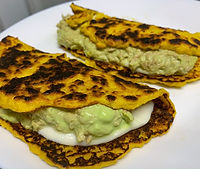
Cachapa
Cachapa is a type of thick pancake made with ground sweet corn, typical of Venezuela. It's grilled and has a juicy, slightly sweet, and very aromatic texture thanks to the fresh corn. It's usually eaten folded or open like an arepa, filled with cheese, butter, ham, meat, or whatever you prefer. It's a simple but delicious dish, closely linked to the countryside and Venezuelan popular cuisine. Fun Facts: Its origin lies in the indigenous tradition of using sweet corn in quick and nutritious preparations. The name "cachapa" comes from an indigenous word related to corn in the Carib language. Unlike arepas, which are made with precooked corn flour, cachapa uses freshly ground kernels, which gives it its characteristic flavor. In Venezuela, it's a very popular street food, easy to find at stalls and fairs. In the Canary Islands, it's well-known and widely consumed by the large community of Venezuelans who emigrated there, bringing their recipes and customs with them. Nowadays, it's not uncommon to see cachapas in restaurants or at food fairs on the islands. It's an example of how the historical relationship between the Canary Islands and Venezuela has enriched Canarian cuisine with flavors from both sides.

Caldera de Las Cañadas del Teide
The Las Cañadas del Teide Caldera is a vast volcanic depression located in the heart of Tenerife, within Teide National Park. It has an elliptical shape and measures between 16 and 17 km in diameter, making it one of the largest calderas in the world. It formed approximately 170,000 years ago when a large volcano, predating Teide, collapsed after its magma chamber emptied. Within it, new volcanic cones emerged, such as Teide and Pico Viejo, which now dominate the landscape. The floor, situated at an altitude of over 2,000 meters, is covered with lava fields and volcanic materials of various colors. Interesting Facts: The original volcano is believed to have reached over 4,000 meters before collapsing. Its name, “Las Cañadas,” refers to the ancient routes used by shepherds and their livestock. The Llano de Ucanca is the largest of these interior plains. It is one of the most studied volcanic landscapes in the world. Although the volcano that created it is extinct, the area remains geologically active, with constant monitoring of gases and earthquakes. It was declared a National Park in 1954 for its natural, geological, and historical value.

Calderón Tropical
The short-finned pilot whale (Globicephala macrorhynchus) is the most common and representative cetacean of Tenerife, especially in the southwest of the island. Although popularly called a whale, it is actually a large oceanic dolphin related to orcas, perfectly adapted to the deep volcanic waters of our archipelago. It lives in stable family groups and has found an ideal habitat here, which has allowed the development of one of the few permanent resident populations in the world, making it a symbol of Tenerife's marine natural heritage. Interesting facts: The population in southwest Tenerife is one of the best studied on the planet, with more than 400 photo-identified individuals. It is one of the few resident populations in the world, as it does not undertake seasonal migrations. Its presence is directly related to the great depths near the coast, a result of the island's volcanic origin. It can dive to depths of up to 1,200 meters to hunt deep-sea squid and octopus. Tenerife is one of the leading international centers for the study and observation of this species. They live in stable family groups, led by adult females, with bonds that last for decades. Clans have been documented in Tenerife that have remained together for more than 20 years.

Camping
Camping in Tenerife is a unique way to experience the island from the inside: sleeping under a starry sky, waking up among pine forests or near the sea, and experiencing nature at your leisure. You must apply for a permit to do so, using the TenerifeOn website. The island has a wide variety of camping areas, from the lush forests of the Corona Forestal to coastal spots overlooking the Atlantic. It's a perfect experience for lovers of the outdoors, hiking, and tranquility, as it combines adventure with a mild climate that allows camping almost year-round. Interesting Facts: In Tenerife, you must obtain prior permission to camp, even in designated and free areas managed by the Cabildo (City Council), such as Las Lajas, Arenas Negras, El Lagar, or La Caldera, available on the TenerifeOn website. Campsites offer different environments: some more family-friendly and well-equipped, and others completely natural, where you can only hear the wind through the pine trees. The island's climate allows for camping both in cool mountain areas and in warmer spots by the sea. It's common to combine camping with hiking, biking, or even astronomical observation nights. Many local campers take advantage of weekends and long weekends to unwind without leaving the island. Camping in Tenerife is also a way to connect with volcanic nature and unique landscapes, from the laurel forests to the lava flows of Mount Teide.

Carabela Portuguesa
The Portuguese man-of-war (Physalia physalis) is not a jellyfish, but a colonial organism made up of specialized individuals that act as a single unit. It appears occasionally in Tenerife and the rest of the Canary Islands, carried by Atlantic currents and winds. Its characteristic blue-violet bladder floats on the surface like a sail, while its tentacles—which can reach several meters in length—remain suspended underwater. Its presence sometimes forces the temporary closure of beaches due to its potent stinging ability. Interesting Facts: It is not a jellyfish, but a colonial siphonophore, composed of organisms that perform different functions (floatation, prey capture, reproduction). Its gelatinous "sail" allows it to move propelled by the wind, without the ability to actually swim. Its tentacles can measure several meters and retain their stinging ability even when detached or stranded on the sand. It inhabits the open waters of the Atlantic, arriving in the Canary Islands seasonally depending on currents and storms. Its sting can be very painful and requires medical attention, especially in sensitive individuals.

Cardón
The cardón (a type of cactus) is one of the most impressive and representative plants of the Canary Islands. It looks like a large cactus, but it's actually a giant euphorbia (Euphorbia canariensis), with thick, green, spiky stems. It can form veritable "forests" in arid, sunny areas, especially in the south of Tenerife and Gran Canaria. It is a resilient plant, adapted to the heat and lack of water, giving the volcanic landscape the wild and unique appearance so characteristic of the islands. Interesting Facts: The cardón (a type of cactus) can grow up to 3 meters tall and live for over 100 years. Although it looks like a cactus, it isn't: it belongs to the same family as the tabaiba (a type of cactus). Its interior contains a toxic white latex, so it should not be touched or cut. It was considered sacred by the ancient Guanches, who saw it as a symbol of strength and endurance. The Cardonal-Tabaibal forest is one of the most iconic ecosystems in the Canary Islands, found primarily in lowland, dry areas. Its ability to survive in volcanic soils makes it a perfect symbol of the Canarian spirit: resilient, tough, and adapted to its land. Some specimens form thickets so large they resemble natural sculptures in the landscape, and within them, they provide refuge for countless other plant and animal species, due to their ability to retain water and provide protection from the sun and predators.